About the work Modern republic

A Diagnosis.
A Warning.
A Call for Restoration.

Fat and Unhappy is a political and moral diagnosis of a republic that has traded discipline for comfort, responsibility for management, and surrendered the duties of citizenship for dependency.
Release Countdown Available September 5, 2026
0Days
0Hours
0Minutes
0Seconds
Fat and Unhappy is now available.
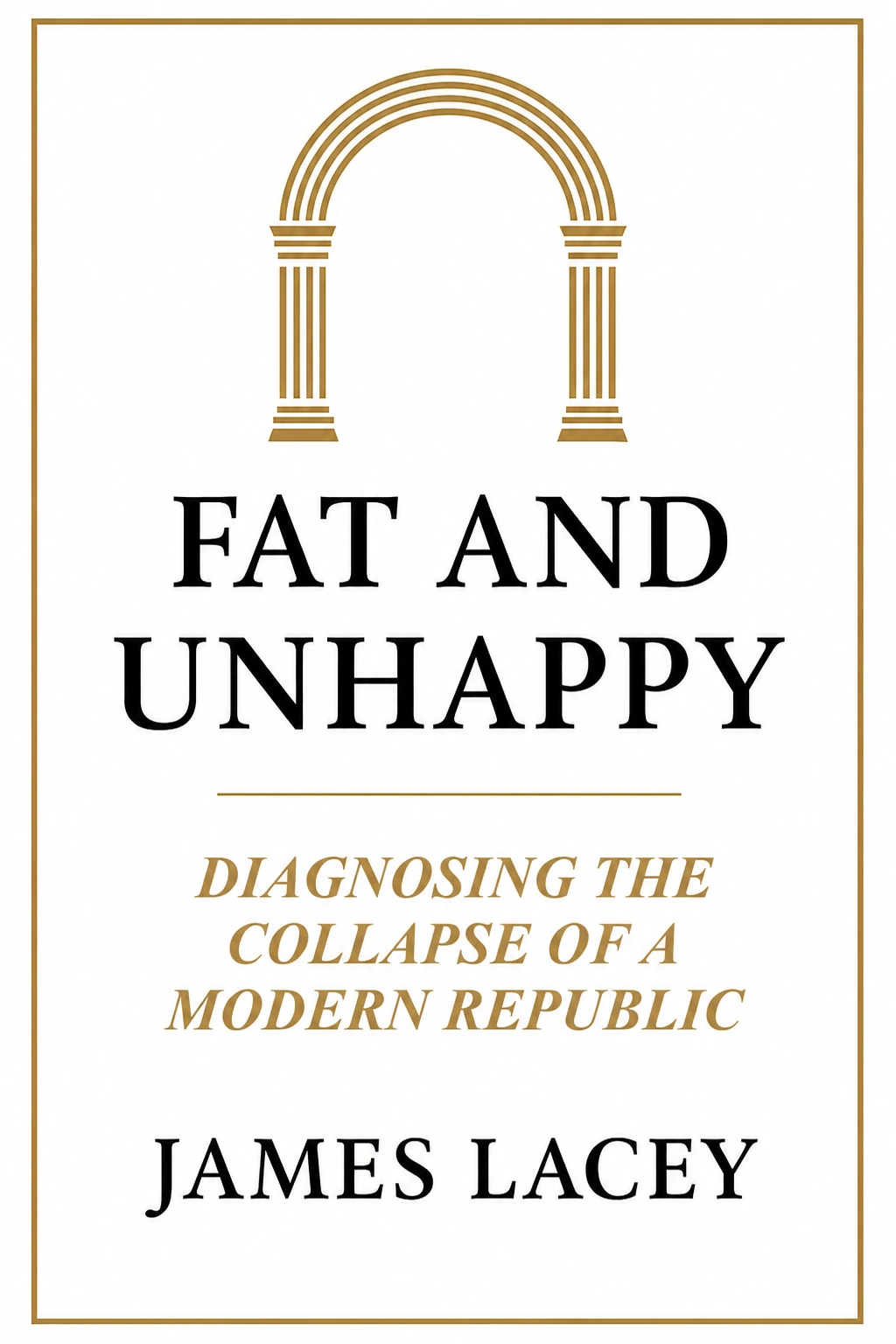
Fat and Unhappy book cover by James Lacey
The book

Diagnosing the Collapse of a Modern Republic

A hard, direct argument about excess, weakness, moral drift, and the restoration of self-command.

In Fat and Unhappy, James Lacey offers a piercing diagnosis of the quiet collapse of the American Republic — not through dramatic tyranny, but through the gentle substitution of comfort for character, management for agency, and indulgence for responsibility.

From the erosion of the family to the machinery of pleasure, from the death of work to the tyranny of therapy, Lacey traces how prosperity has bred physical and moral excess, producing a citizenry fat in flesh yet starved in spirit.

This is not a lament. It is a call to reclaim self-command, restore civic virtue, and rebuild the moral architecture of a free people. Freedom is not a gift to be consumed. It is a responsibility to be carried.

18Chapters
5Parts
Relevance
Inside the book

The Condition. The Fracture. The Decay. The Illusion. The Restoration.

The book follows the manuscript’s full architecture: dependency and pleasure in Part I, family and meaning in Part II, work, education, and virtue in Part III, indulgence, therapy, truth, and conscience in Part IV, and finally the recovery of responsibility, citizenship, and the republic in Part V.

PART I — THE CONDITION
Chapter One

The Anatomy of Dependency

How modern systems replace self-command with managed survival.

Chapter Two

The Machinery of Pleasure

Pleasure as governance, indulgence as pacification, and dopamine as policy.

Chapter Three

The Politics of Compassion

How mercy became management and charity became control.

Chapter Four

The Politics of Dignity

Why dignity cannot be granted, affirmed, or administered—and what happens when it is.

PART II — THE FRACTURE
Chapter Five

The Collapse of the Family

The destruction of the primary civilizing institution and the rise of state parenthood.

Chapter Six

The Crisis of Masculinity

The pathologizing of strength, the abandonment of boys, and the consequences of fatherlessness.

Chapter Seven

The Crisis of Meaning

Nihilism, identity substitution, and the spiritual vacuum beneath modern life.

PART III — THE SYSTEMS OF DECAY
Chapter Eight

The Death of Work

From vocation to transaction, from labor to leverage, from dignity to dependency.

Chapter Nine

The Failure of Education

Schools without formation, credentials without competence, knowledge without wisdom.

Chapter Ten

The Failure of Virtue

Why law, policy, and incentives cannot replace character.

PART IV — THE CULTURE OF ILLUSION
Chapter Eleven

The Economy of Indulgence

Consumption as anesthesia and credit as cultural narcotic.

Chapter Twelve

The Tyranny of Therapy

When suffering becomes identity and healing replaces responsibility.

Chapter Thirteen

The Death of Truth

Emotion over reality, censorship over discourse, safety over honesty.

Chapter Fourteen

The Silence of Conscience

Why good men say nothing—and what that silence costs.

PART V — RESTORATION
Chapter Fifteen

The Restoration of Responsibility

The return of consequence, self-command, and earned freedom.

Chapter Sixteen

The Rebuilding of the Citizen

Habits, discipline, restraint, and the moral architecture of self-government.

Chapter Seventeen

A Republic Without a Soul

Administrative rule, procedural democracy, and the hollowing of citizenship.

Chapter Eighteen

Recovering the Republic

Cultural renewal, institutional repair, and the long work of restoration.

EPILOGUE
Epilogue

The Cost of Freedom

Why liberty survives only where men are willing to pay the cost.

James Lacey standing on stone steps in a dark suit and black knit cap
About the author

James Matthew Lacey

James Matthew Lacey is a writer, tradesman, and mechanical engineering student whose work bridges the world of labor and the world of ideas. Raised in a large family of ten children, he writes from the pressure and consequence of ordinary American life rather than from institutional distance.

A Production Operator II at Indium Corporation, Lacey brings the moral realism of the factory floor to his diagnosis of modern decline. His work is built around discipline, responsibility, family, restoration, and the belief that civilization depends on the character of the people who inherit it.

“I write not from the ivory tower, but from the floor — where consequences are measured in shifts worked and promises kept.”

Author Contact: jlacey.author@gmail.com

Launch page

The Republic is not a machine to be managed. It is a soul to be restored.